





Jobsite Ideas Turned Into Real Tools: Pipe Site & Nut Zipper


Most tool ideas start with a simple thought on the jobsite: there has to be a better way to do this. For electrician Cody Titus, those moments turned into real inventions. After long shifts working conduit and wire in data centers, he began teaching himself CAD and using 3D printers to prototype tools that made the work easier. What started as small side projects eventually turned into products used by electricians across the trade. In this interview, Cody shares how he got started and the problems that inspired his tools.
From the Jobsite to the Workbench
Rack-A-Tiers: Tell us about yourself and how you got into the world of inventing new tools for electricians.
Cody: My name is Cody Titus. I’ve been a journeyman electrician for six years and in the industry for around ten years. I’ve done a lot of conduit work, underground work, and lots of different types of work.
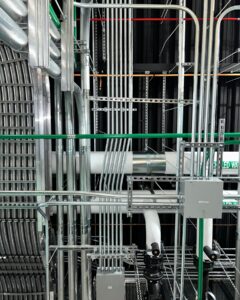
I was working in a data center, and there was quite a bit of pipe and wire. There were a lot of tools that I wanted to make things easier, but I found that didn’t exist. I took it upon myself after work every day to go home and figure out a way to make these tasks better. Mostly just for myself, but I also thought that if anybody was interested in buying them, that’d be cool.
I started my own website, bought a few 3D printers, and got familiar with CAD. I taught myself how to use it and I would brainstorm ideas for different tools that I might find handy, and started making them. I brought them into work and let the guys play with them to see what they thought because I wanted an honest reaction to how useful these things are.
People loved them, so I just went from there and found the Rack-A-Tiers inventor program and where I talked to the boss man himself. Everybody seems excited about my products.
Pipe Site: Your New Conduit Laser
 Rack-A-Tiers: When you were working in the data center and dealing with all that pipe, what gave you the idea to invent a conduit laser?
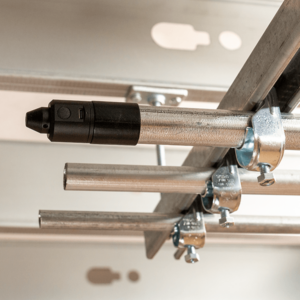
Cody: When you’re doing lots of conduit work, you will invariably have to drill a hole to get your conduit run through a wall. Not so bad with one pipe, but it gets really annoying when you have a dozen or more pipes. The old method was taking your tape measure and using common surfaces like the floor or a nearby wall to lay out the conduit. My idea was that if you had a laser pointing where the conduit is pointing, you would know where to drill.
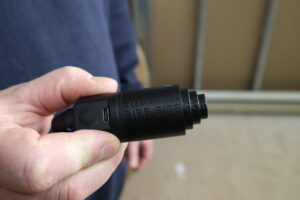
I went home, and I 3D printed a piece for a bore sight laser for sighting a pistol. Now you can just turn your laser on, put it on the pipe and have a laser dot on the wall. You don’t even have to touch a tape measure.
Nut Zipper: Save Hours of Manual Nut Spinning
 Rack-A-Tiers: One tool you invented that it seems like electricians can’t imagine working without now is Nut Zipper. What was the situation that gave you the idea for it?
Cody: When working in a data center, they try to prefab as much of your work as possible, so you just have to install it. When you have a pipe rack, you have two long pieces of all-thread rod that can be 10, 20, 30, or 40 feet, and then you’ll have three or four tiers of strut that your pipes go on. They prefab that whole thing and give you two dozen of them on a big cart and say, “Go ahead and install it. Should be ready to go.”
Then you go to install it, and the tiers are not at the right level. They can be a foot or more off sometimes for whatever reason. And so, we have to go up there to install the rack, then take down every tier, move them to the right spot, and tighten them back down. I was working nights, and I spent entire nights adjusting racks.
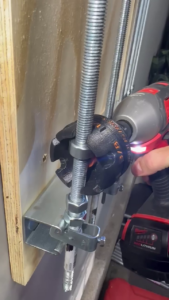
I developed the Nut Zipper to make installing or adjusting racks much faster and easier. It attaches to your drill so you can use it at any point along the rod and run the nut up and down with your drill. It’s not fiddly like when guys put a screwdriver with a rubber handle on their drill to spin the nut. This is a lot simpler and more straightforward.
Check out the Nut ZipperThe Hidden Difficulties of Tool Invention
 Rack-A-Tiers: What’s been the most difficult part of the tool invention process for you?
Cody: The easy part is designing stuff because brainstorming an idea and then designing it is fun for me. The hard part for me has been advertising and finding customers who would be interested and then selling it to them, because I’m antisocial.
Rack-A-Tiers have been a massive help in that regard. They know the trade shows and the contractors. They have the audience and have been very helpful in guiding me in what I should be doing. Things like making videos and talking about my story.
Rack-A-Tiers: What do your family and friends think now that you’re a big shot inventor?
Cody: All of my family and friends are in construction or some kind of manual labor field. I don’t know any business owners or inventors. I don’t know anybody who’s interested in CAD or 3D printing. This has all been my own foray into the dark, and I’ve been learning as I go. Everybody’s been very supportive, and they all think it’s super cool, and they wonder why I’m not a millionaire.
As far as useful advice goes, that’s been lacking. I’ve been on my own. So again, coming in with Rack-A-Tiers and meeting other inventors and guys who know manufacturing and sales has been good. It’s been kind of a breath of fresh air for me because I can talk to people who speak my language.
What to Know When Inventing Your First Electrical Tool
 Rack-A-Tiers: For the electricians reading this who have tool ideas or what to get started inventing, do you have any advice about how they should get started?
Cody: All these products have come out of necessity. I know it doesn’t sound glamorous, but go to work every day and do the best you can at your job while keeping in the back of your mind, “how could this be automated? How could this be made easier?” If it makes a contractor money and saves you time, then it’s probably a good idea.
At the end of the day, I always try to take pride in my work and my inventions. I try not to become emotionally attached to them because you can find yourself in a situation where you think something is really good, and maybe other people don’t see it as valuable as you do.
Your product must be useful regardless of how you feel about it. If somebody else can’t pick it up and find some benefit in it then it’s maybe not worth pursuing. Don’t worry about it. Just move on to the next idea. There are a million ideas out there.
For Electricians, By Electricians
Big thanks to Cody for taking the time to share his story and walk us through the ideas behind his tools. It’s always great to hear how real jobsite problems turn into practical solutions. If you’re an electrician with ideas of your own, hopefully Cody’s experience shows that getting started might be simpler than you think. Click here to visit the Rack-A-Tiers Inventors Corner to submit your tool ideas.
Tool Recap: Pipe Site & Nut Zipper
Pipe Site
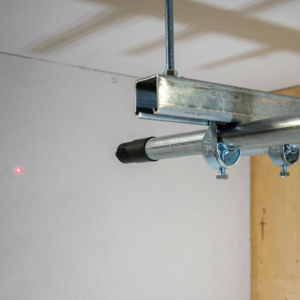 This makes laying out your pipe work way faster. Just turn the laser on and put it onto the pipe of your choice to create a laser dot on the wall or on the panel so you know right where to do your hole saw, penetration, or pipe termination. It’ll work with rigid pipe, EMT, PVC, copper, or any kind of pipe you want.
Nut Zipper
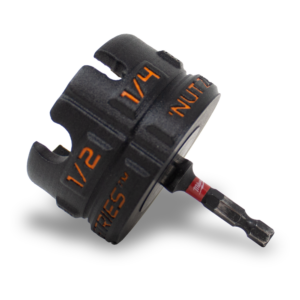 Meet the drill-operated attachment that speeds up nut installation on threaded rods, making it perfect for conduit racks and fixtures.

