





Best Electrician Tools for Commercial Work? @ADBElectric.Inc Breaks It Down


Use Coupon Code “adbelectric10” for 10% Off Your Next Rack-A-Tiers Order!
Daniel: Okay, hello everybody! My name is Daniel. I’m with the company ADB Electric. We are in California and do mostly industrial and commercial electrical, but we do some residential work. For all the jobs that I do, I always love to use Rack-A-Tiers tools because they have the right tools that we need daily. You’ll find Rack-A-Tiers really provides tools to make your job easier and more efficient to get it done the right way.
Standout Electrical Tools According to @ADBElectric.inc
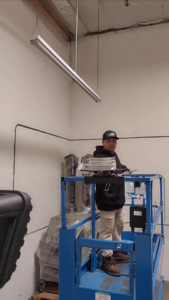 Rack-A-Tiers: What kind of jobs have you been working on lately? Any cool projects or tools that stand out that people would be interested in reading about?
Daniel: The last job that we did was some commercial work for OC Tool House. We did all the lighting for them. We used a bunch of Rack-A-Tiers tools, like the new fish sticks that you click together. We used them to fish in the wires for all the recessed lights that we did.
We also did some work on the industrial side, where we used the Skybender on a scissor lift. It saves you a lot of time by not having to go down the scissor lift to make your bends. We did a lot of wiring on some new panels, so we used the Penguin Puller instead of making loops at the end of the wire, which saves you a lot of time. With the Penguin Puller, you can just strip it at the end and then snap it inside, lock it down, tighten the Allen keys, and you’re good to go. We’ve been working with the Wire Waffle, too. Those things are amazing. Those things are really nice for everybody who does residential work.
Check Out Rack-A-Tiers' Top Products
How to Wire a Tool Showroom
Rack-A-Tiers: The OC Tool House job seems like an interesting one. Can you walk us through the process of wiring up a tool showroom from start to finish?
Daniel: The first day that we arrived at OC Tool House, I had my apprentice working with me, and we went over to check out the demolition. The demolition was just tearing down some walls and then taking down some switches that were on the way, and cleaning up as much as we could for them to start remodeling the place.
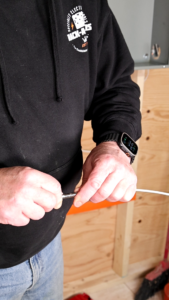 The next day, we went over, and the walls were down already, so we started running some new wires. The problem was that they didn’t have as much space between the roof and the ceiling, so we couldn’t get from one light to the other light. That’s when we used the Rack-A-Tiers Click ‘N’ Fish sticks to fish down the wire for each individual light. You put it together, put the wire and then at the other end, start pulling the wire with it.
Rack-A-Tiers: How did the Click ‘N’ Fish compare to other fish sticks or fish tapes you’ve tried?
Daniel: It was really good because, when you have other kinds of sticks, sometimes you end up poking or scratching the walls. The Rack-A-Tiers’ fish sticks come in pieces. You screw them together to decide the length based on the distance between the other light. We were able to fish all the wires for the lights without damaging or scratching the walls.
Fixing Exposed Wire Splices
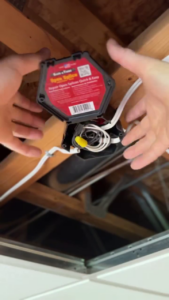 Rack-A-Tiers: What was the next step after running those wires?
Daniel: After that, we had to go up to the attic, where we found some open boxes and some wire splices that were not enclosed. So that was not up to code. That was done totally wrong. I keep some Open Splice Junction Boxes inside my truck because they don’t take up too much space. I just told my apprentice to go to the truck, grab me a couple of those, and bring them back to me so I could show him how splices can be properly secured inside the box without remaking splices.
All you do is open it, push in the notches on each side, and then screw the box down with a double-ended impact bit and that’s about it. We did that at OC Tool house in a few places in the attic and that job came out really nice because at the end of the day, all those splices were capped off and safe.
Buy Open Splice Junction Box Here!
The BEST Way to Strip NMSC Wire
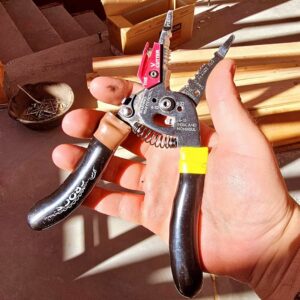 Rack-A-Tiers: So, you ran wire through the attic and got everything up to code. What was next, installing lights and switches?
Daniel: We were doing all the recessed lights with Romex running from one light to another. I was using Croc’s Wire Strippers with the V-Cutter to make splices and to cut my Romex. It’s much easier than using my pocketknife and damaging the wire. When you use the V-cutter, you just attach it to your Croc’s, and it’ll cut like butter. We ended up installing about 40 lights for them in the whole showroom.
After that, we ended up running our switches for all the lighting. We used the Ferret Inspection Camera to find the right hole for the wires because we had no space in the attic. Without the Ferret Camera from Rack-A-Tiers, I wouldn’t have been able to be able to see obstacles or where to run the wire.
Next, we installed the switches for them and tested them. Everything was working perfectly.
Finishing Touches: Installing a Low-Voltage Sign
 Rack-A-Tiers: What are the last steps to a big job like that?
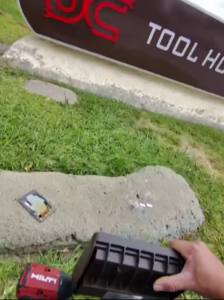
Daniel: The last thing we had to do was put the sign for OC Tool House outside. We ended up running power for the sign by bringing the wire through the attic using the fish sticks. And then after that, we were completely done with the job.
Rack-A-Tiers Tools Reviewed by a Commercial Electrician
A big thanks to Daniel for taking the time to chat with us and walk us through this one. It’s always great to hear how someone actually uses these tools out in the field on real jobs. If you want to see more content like this, go give @ADBElectric.inc a follow. Daniel posts regularly and has plenty more tool tips and project breakdowns worth checking out.
Rack-A-Tiers Tools Used on This Job
Here’s a quick rundown of every Rack-A-Tiers tool Daniel mentioned on the OC Tool House job.
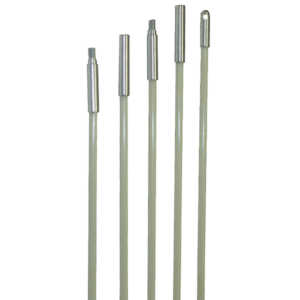
A push-connect fish stick system that snaps together so you can dial in the exact length you need. Comes with a variety of heads and hooks, and the glow-in-the-dark material makes it easy to work in low-light conditions.
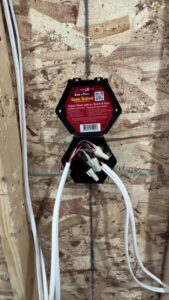
A one-piece junction box that encloses open wire splices without any rewiring. Position the splice inside, close the lid with four screws, and you’re up to code.
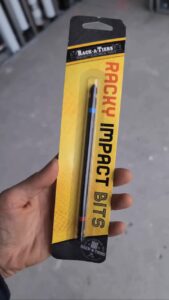
A full lineup of driver bits built for electricians, including double-ended impact bits, hex bits, Robertson, Phillips, and more.
Croc’s Needle Nose Wire Strippers
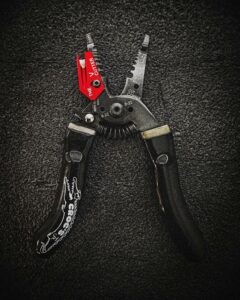
A multi-use wire stripper that handles 10-22 AWG and 14/2 and 12/2 NM cable, cuts machine screws, and crimps terminal connectors. All-in-one ergonomic tool with glow-in-the-dark handles.
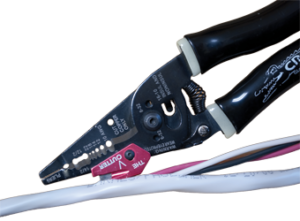
A blade attachment that clips onto most wire strippers and lets you strip NMSC cable with a single swipe, without nicking the wire insulation.
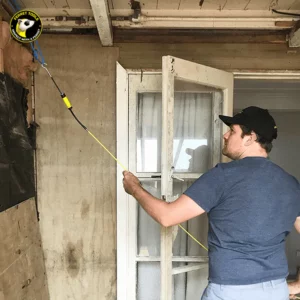
wireless inspection camera that streams 720p HD video to your phone via built-in WiFi. Waterproof with adjustable LEDs and app-controlled variable focus. See exactly what’s in the wall before you pull wire.
Skybender Lift-Mounted EMT Bender
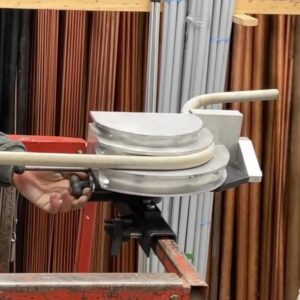
The only EMT bender that mounts directly to a scissor or boom lift. Bends 1/2″, 3/4″, and 1″ EMT and includes a built-in pipe reamer and straightener so you never have to leave the platform.
Wire Waffle Multiple NM Cable Connector
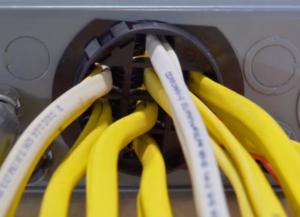
A panel knockout connector that fits a 2.5″ KO and runs up to 16 NM cables through a single hole. UL-listed and NEC 312.5(c) compliant.
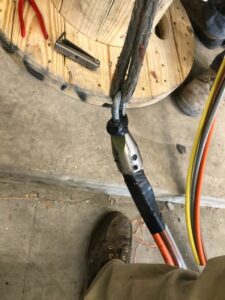
A bullet-shaped wire pulling attachment rated for up to 4,000 lbs. Strip the wire, lock it into one of four slots with Allen-key set screws, attach your rope, and pull. No tape or crimps needed.

